The Karnat (Karnata) dynasty founded the medieval kingdom of Mithila and gave the region roughly two and a quarter centuries of unified rule, conventionally dated 1097–1324 CE. Its founder, Nanyadeva, was a warrior whose family tradition traces to the Karnataka south (hence “Karnat”), and his accession is among the most precisely datable events in Mithila’s history: an inscribed pillar records that “in the Shaka year 1019… king Nanyadeva took the land,” corresponding to 10 July 1097 CE. He established his seat at the great fortified city of Simraungadh, on what is now the India–Nepal border in Bara district, Madhesh.
The dynasty’s principal rulers are usually listed as Nanyadeva (r. c. 1097–1147), Gangadeva, Narasimhadeva, Ramasimhadeva, Shaktisimhadeva and Harisimhadeva (to c. 1324). These regnal dates should be read as approximate and reconstructed — they vary across sources and are inferred from inscriptions, chronicles and later genealogies rather than from a continuous record. Nanyadeva himself was remarkably a musicologist as well as a king, author of a Sanskrit treatise on music (the Bharatabhashya) later cited by the 13th-century authority Sharngadeva — a philosopher-king in the old Janaka mould.
The Karnat era was a cultural high-water mark. It saw Gangesha Upadhyaya found the Navya-Nyaya (“new logic”) school that would make Mithila the leading centre of Indian philosophy for centuries, and Jyotirishwar Thakur compose the Varnaratnakara (early 14th c.), often called the earliest surviving prose work in Maithili. Tradition holds that the last great king, Harisimhadeva, instituted the Panji system of genealogical record-keeping around 1326 — the institution that still defines Maithil social memory.
The kingdom fell to the Delhi Sultanate. In 1324 CE, Ghiyasuddin Tughlaq, returning from a Bengal campaign, attacked Mithila; Harisimhadeva, rather than make a stand, abandoned Simraungadh and fled north into the Himalayan foothills of present-day Nepal. (Sources agree on the 1324 invasion but differ on later detail: Harisimhadeva is generally said to have reached the Dolakha/Nepal hills and died around 1326, and some of his line are linked to later Nepali ruling houses — a point where documented history shades into chronicle tradition.)
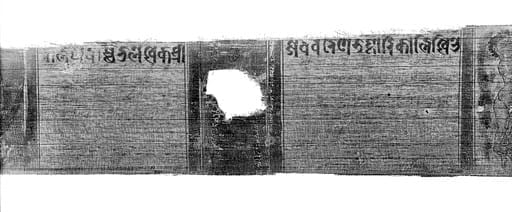
The Karnat legacy is the very framework of medieval Mithila: a unified kingdom, a fortified capital whose earthwork ruins and Tirhuta-script inscriptions still survive at Simraungadh, the flowering of Navya-Nyaya and early Maithili letters, and the Panji institution — foundations on which the succeeding Oiniwar and Darbhanga dynasties would build.